

Brute-Knight Dichotomy
Flipping over the coin of the Maddona-Whore

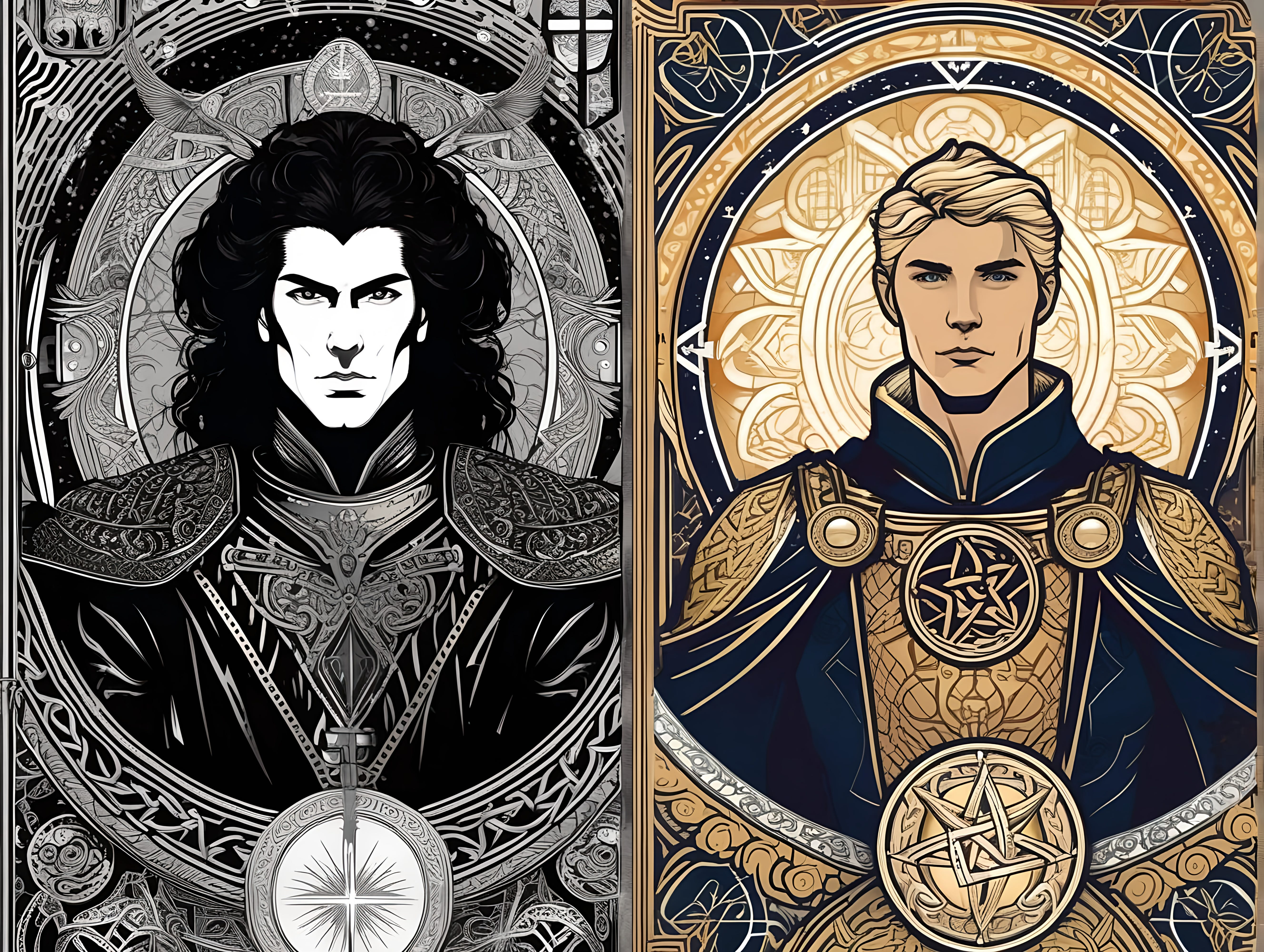
Picture a grand, old library, filled to the brim with books.
Now, imagine an odd librarian who insists on categorizing the books into only two sections - sacred texts and pulp fiction. In the mind of the confused librarian, the sacred texts are the epitome of virtue and wisdom, to be revered, cared for and studied. The pulp fiction, on the other hand, is the guilty pleasure, to be consumed and discarded without a second thought.
It's as absurd as a vegan at a bullfight, but that's the Madonna Whore complex in a nutshell.
We often hear about the Madonna-Whore complex, a concept that's been a veritable hit since Freud introduced it. Men, apparently, subdivide women into two categories: the virtuous 'Madonna' and the promiscuous 'Whore.' This construct is frequently employed as a bludgeon to highlight male misogyny, encapsulating a fundamentally sexist view that reduces women to narrow, one-dimensional stereotypes.
Now, let's flip the script. Ever heard of the Knight-Brute complex? No? Well, that's hardly surprising. While men are repeatedly taken to task for their Madonna-Whore perceptions, women's equivalent psychological dichotomy, the Knight-Brute complex, often slips under the radar.
You see, if men are guilty of dichotomizing women into Madonnas and Whores, women are just as culpable of splitting men into Knights and Brutes. The former are the 'good guys,' the Knights the ideal man, reliable, morally upright, embodying stability, dependability, and emotional availability. In essence, he’s the type of man who checks off all the boxes in the traditionally accepted script of what makes a 'good' partner.
The Brute, on the other hand, symbolizes the archetypal thrill of the 'bad boy.' He's raw, exciting, and often unpredictable, alluring in their unpredictability and raw charisma. He possesses a certain charisma that is undeniably magnetic and incomparably attractive, yet he might not fit the conventional standards of what constitutes a 'suitable' partner.
In this dichotomy, the Knight is akin to the Madonna figure, seen as the more socially acceptable and 'safe' choice. He’s the one who is dependable, someone to whom a woman can entrust her future and that of her potential offspring. He is, in traditional terms, 'husband material.' However, he is often considered the boring choice; safe, staid, and always there waiting for you.
The Brute, similar to the Whore, is the more sexually alluring, thrilling, and dangerous option. He's the one who keeps a woman on her toes, the one who exudes an irresistible sexual energy. Although exciting, he is rarely considered to be the best choice for a stable, long-term relationship, due to his nature being generally less mature, reliable and, in a nutshell; agrestal.
The Knight-Brute complex presents a fascinating study in how social conditioning and biological impulses collide. Women are often socially conditioned to seek out the Knight, the provider and protector, for long-term commitments. Simultaneously, they might feel a primal, biological attraction to the Brute due to his raw energy and sexual charisma.
Again, in one corner, we have the Madonna-Whore complex, the infamous cognitive distortion plaguing men for centuries. You've got the pristine Madonna, all virtue and sanctity. But where's the spice, you ask? Enter the Whore, the embodiment of lustful, sensual femininity. Too bad she's not 'wife material.'
Let's switch gears to the other corner. We find the Knight-Brute complex waiting, brooding in the shadows. It's the same song with different lyrics. Here, we have our knight in shining armor. Mr. Dependable, Mr. Responsible, the ideal husband - financially secure, emotionally stable. He's the Madonna in pants.
Then there's the Brute, the untamed bad boy, oozing a magnetic, raw sexual energy that's irresistible. Women want him, but they're told they shouldn't. He's the equivalent of the sultry siren from the Madonna-Whore complex, enticing but not quite the man you bring home to mother.
These two constructs work in parallel, mirroring each other's oversimplification and polarization. They place men and women on pedestals, forcing them to be one-dimensional caricatures. It's like living in a world of pop-up books where everyone is flat and predictable.
This binary worldview leaves no room for the grey area. Men are either the noble savior or the dangerous outsider. Women are either pure Madonnas or sensual Whores. It's a simplistic dichotomy, a mere illusion of understanding the opposite sex.
What these constructs fail to consider is that humans are complex creatures, not comic book characters. The Knight can be exciting, and the Brute can be nurturing. The Madonna can have a wild side, and the Whore can be virtuous.
By reducing individuals to these roles, we're creating a recipe for disappointment. Unrealistic expectations are set, leading to frustration and heartache. No one is all saint or all sinner, all Knight or all Brute.
Yet, there seems to be a reluctance, or perhaps even a selective blindness, towards acknowledging the existence of the Knight-Brute complex. While the Madonna-Whore construct has been roundly criticized and considered an emblem of deep-seated male sexism, the Knight-Brute dichotomy escapes similar scrutiny.
The disparity in the societal reaction to these two analogous complexes shines a spotlight on an often overlooked form of bias. Men are vilified for their categorization of women into Madonnas and Whores, yet women's categorization of men into Knights and Brutes is largely ignored, even though both frameworks essentially commit the same crime of reducing the opposite sex to simplistic, binary stereotypes.
Perhaps the root of this inconsistency lies in societal norms and expectations. Men are expected to desire and value women for more than their virtue or lack thereof, whereas women's preferences for dependable Knights or exhilarating Brutes are seen as less problematic, even justifiable. This is a quintessential example of societal double standards, subtly coded into our collective understanding of gender roles.
This perception is a disservice to men, much like the Madonna-Whore complex is to women. It stifles men, forcing them into restrictive roles, denying them the freedom of multi-dimensionality.
It also fails women, who end up expecting too much or too little from their partners. There's no room for flaws in Mr. Knight and no room for redemption for the Brute.
But here's the kicker. Women don't consciously choose this. It's a societal construct, a psychological conditioning that seeps into the subconscious. It's not personal preference; it's societal pressure.
This complex doesn't acknowledge the myriad forms of masculinity. It doesn't consider that men, like women, are multi-faceted beings. It strips them of their individuality, reducing them to archetypes.
It's the product of a society that promotes polarized gender norms, a society that feeds on stereotypical roles and refuses to acknowledge complexity. It's a societal echo chamber, a self-fulfilling prophecy.
Ironically, the Knight-Brute complex, much like the Madonna-Whore complex, leads to dissatisfaction. It traps women in a cycle of unrealized expectations, fostering resentment and disillusionment.
In reality, the Knight and the Brute are two sides of the same coin. They represent desirable traits, but they should coexist, not dominate. The ideal man is a blend of both.
Ultimately, both the Madonna-Whore complex and the Knight-Brute complex offer a myopic lens to view the opposite sex, leading to misconceptions and prejudiced expectations. They undermine the fact that human beings are intricate, multifaceted creatures who cannot be neatly pigeonholed into simplistic categories.
For any significant progress towards gender equality and mutual understanding, we need to address these biases in their entirety. Recognizing the Knight-Brute complex and treating it with the same scrutiny as the Madonna-Whore complex is a step in that direction. It is time we understand that simplistic stereotypes, regardless of who they target, do not serve our understanding of the complex human nature.
It sounds like you are trying to summarize a extremely simple concept in a way that makes you sound like an intellectual. You don't really engage with anything someone alive wouldn't know, your elucidations in these articles are not anything incredible. Your general pride is readable but a little dry: like a imitation of someone better who themself isn't noteworthy.